


























- -10%
- -10%

0
Vanaheim.pl uses cookies. If you browse our website, we assume that you accept our cookie policy.
Free shipping on orders above 400 PLN within Poland
 Preorder
 Games Workshop

 Miniature Games


Fantasy
 Card games
Other card games
 Board Games
 Paint & Modelling


 Accessories


 Books & RPGs
 More ...
SCENA LOKALNA
Games Workshop
Miniature Games
Card games
Board Games
Paint & Modelling
Accessories
Books & RPGs
More ...
SCENA LOKALNA

Loyalty Points
 By buying this product you can collect up to
3
point
points.
Your cart will total 3
points that can be converted into a voucher of
zł1.20.
By buying this product you can collect up to
3
point
points.
Your cart will total 3
points that can be converted into a voucher of
zł1.20.
Collect 3 Points for this product
In physical stock
This item is readily available at our hobby store in Kraków.

We have this item in our hobby store.
Free Delivery
Free express shipping on orders over $100.00
Delivery within 3 days.
The exact terms and conditions will be available after registration.
Free delivery all over Poland
Guarantee
Please Note: Items in this category are not able to be returned or exchanged, please understand.

We guarantee quality delivery
Payment Security
Please Note: Items in this category are not able to be returned or exchanged, please understand.

We guarantee quality delivery
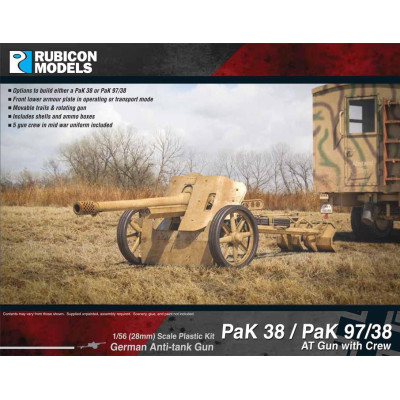
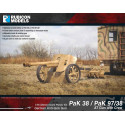
PaK 38 / PaK 97/38 AT Gun with Crew
W 1939 władze Niemieckie potrzebowały nowych dział przeciwpancernych. Tą potrzebę spełniła armata Pak 38 i zmodyfikowane Pak 97/38. Działa te odegrały dużą rolę na początku wojny podczas pierwszych inwazji. Używane były przez cały okres 2 wojny światowej.
Zestaw zawiera możliwość złożenia modelu działa Pak 38 lub Pak 97/38
After the Spanish Civil War, the German authorities started to think that a new anti-tank gun would be needed, even though the 3.7cm PaK 36 had proven to be very successful. They asked Rheinmetall-Borsig to produce a new and more capable AT-gun. They first designed the PaK 37 in 1935, but the German authorities didn’t approve it because of its low capabilities. Rheinmetall-Borsig was forced to create a new gun under the designation PaK 38, which fitted a new and longer L/60 barrel and was approved for mass production in 1939.
The 5cm PaK 38 (L/60) (5cm Panzerabwehrkanone 38 (L/60)) was first used by the German forces in April 1941. When the Germans faced Soviet tanks in 1941 during Operation Barbarossa, the PaK 38 was one of the few early guns capable of penetrating the 45mm (1.8 in) armour of the T-34. The gun was also equipped with Panzergranate 40 APCR shots with a hard tungsten core, in an attempt to penetrate the armour of the heavier KV-1 tank.
Although it was replaced by more powerful weapons, it remained a potent and useful weapon and remained in service with the Wehrmacht until the end of the war. Between 1940 and 1943, a total of 9,566 units were built.
During the invasion of Poland and France, the Wehrmacht captured thousands of 75mm Model 1897 guns, built by the French arms manufacturer Schneider. Soon after the German invasion of the USSR in 1941, Wehrmacht units encountered new Soviet tanks, the medium T-34 and the heavy KV. The thick sloped armour of these vehicles gave them invulnerability against German towed 3.7cm PaK 36 anti-tank guns. The situation led to requests for more powerful weapons that would be able to destroy them at normal combat ranges.
Even though Germany already had a suitable design, the 7.5cm PaK 40, this weapon entered production and the first pieces were delivered in November 1941. However, until enough of these were manufactured, some expedient solution was required. In its original configuration, the French guns were ill-suited for the anti-tank role because of their relatively low muzzle velocity, limited traverse (only 6°) and lack of a suitable suspension (which resulted in a transport speed of just 10 to 12 km/h). It was decided to solve the traverse and mobility problems by mounting the 7.5cm barrel on the modern split trail carriage of the 5cm PaK 38 anti-tank gun. To soften the recoil, the barrel was fitted with a large Swiss Solothurn muzzle brake. The gun was primarily intended to use HEAT shells as the armour penetration of this type of ammunition does not depend on velocity.
The 7.5cm PaK 97/38 reached the battlefield in the summer of 1942. Despite moderate effectiveness and violent recoil, it remained in service until the end of the war. A total of 3,712 units were built between 1942 and 1943.
Product Highlights:
- Options to build either a PaK 38 or PaK 97/38
- Front lower armour plate in operating or transport mode
- Movable trails & rotating gun
- Includes shells and ammo boxes
- 5 gun crew in mid-war uniform included
Product Code: 280058
Number of Parts: xx pieces / 1 sprue + 2 figure sprues
Choose 'in-store pickup'. You can pay upfront or upon collecting goods at the counter. You will get a notification e-mail once your order is ready for pickup. In case of products marked 'Ships within 24 hours' and available in desired quantities, you can assume your order is ready to collect at once!
From the moment of completion your order will wait for you for up to 7 days.
Armata Pak 40 była standardowym niemieckim działem przeciwpancernym opracowanym w latach 1939-1941 i używanym przez cały okres 2 wojny światowej. Zestaw zawiera model Pak 40 wraz z jego obsługą
Lekki wóz bojowy armii niemieckiej Sd.Kfz 250 half-track używany w czasie 2 wojny światowej. Zestaw zawiera części do złożenia 1 Sd.Kfz 250 wersji 250/1, 250/9 lub 250/11 i zawiera modele załogi
Produkcję R75 rozpoczęto w 1938 na prośbę Niemieckiej armii. Produkowany był do 1944.Zestaw zawiera model niemieckiego motocykla z gondolą i trzy modele załogi.
Lekki wóz bojowy armii niemieckiej Sd.Kfz 250 half-track używany w czasie 2 wojny światowej.Zestaw zawiera możliwość złożenia wariantu 250/3 i 250/10.


