

























- -10%
- Out of Stock, Cannot be ordered
- -10%

0
Vanaheim.pl uses cookies. If you browse our website, we assume that you accept our cookie policy.
Free shipping on orders above 400 PLN within Poland
 Preorder
 Games Workshop

 Miniature Games


Fantasy
 Card games
Other card games
 Board Games
 Paint & Modelling


 Accessories


 Books & RPGs
 More ...
SCENA LOKALNA
Games Workshop
Miniature Games
Card games
Board Games
Paint & Modelling
Accessories
Books & RPGs
More ...
SCENA LOKALNA

Loyalty Points
 By buying this product you can collect up to
3
point
points.
Your cart will total 3
points that can be converted into a voucher of
zł1.20.
By buying this product you can collect up to
3
point
points.
Your cart will total 3
points that can be converted into a voucher of
zł1.20.
Collect 3 Points for this product
Free Delivery
Free express shipping on orders over $100.00
Delivery within 3 days.
The exact terms and conditions will be available after registration.
Free delivery all over Poland
Guarantee
Please Note: Items in this category are not able to be returned or exchanged, please understand.

We guarantee quality delivery
Payment Security
Please Note: Items in this category are not able to be returned or exchanged, please understand.

We guarantee quality delivery
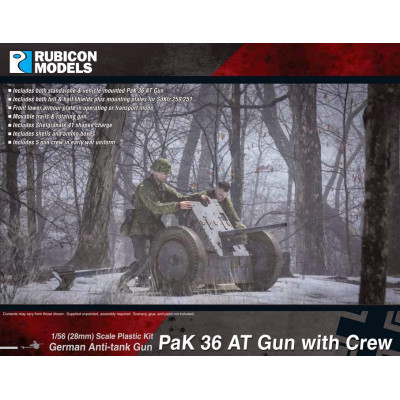
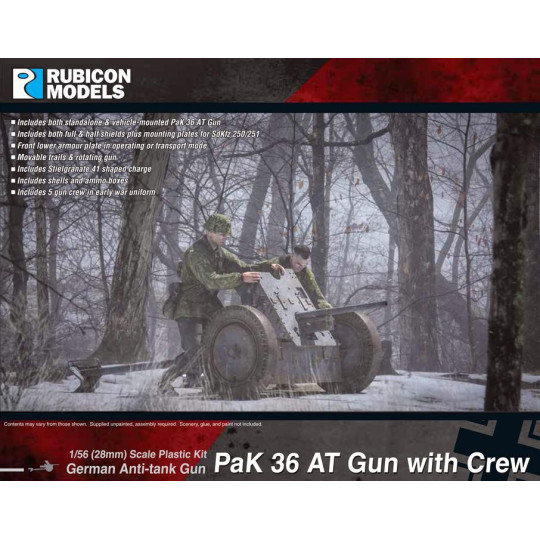
PaK 36 AT Gun with Crew
Pak 36 był główną bronią przeciwpancerną Wehrmachtu. Działo zostało pierwszy raz użyte w 1936 podczas wojny domowej w Hiszpanii. Od końca 1940 Pak 36 był powoli zastępywany przez nowsze modele.
Zestaw zawiera działo przeciwpancerne Pak 36 wraz z obsługą.
The PaK 36 (Panzerabwehrkanone 36) was a 3.7 cm calibre German anti-tank gun used during the WW2. It was the main anti-tank weapon of Wehrmacht infantry units until mid-1941.
Design of a horse-drawn, 3.7 cm anti-tank gun (designated 3.7 cm PaK L/45) by Rheinmetall commenced in 1924 and the first guns were issued in 1928. By the early 1930s, it was apparent that horse-drawn artillery was obsolescent, and the gun was modified for motorized transport by substituting magnesium-alloy wheels and pneumatic tyres for the original spoked wooden wheels. Re-designated the 3.7 cm PaK 35/36, it began to replace the 3.7 cm PaK L/45 in 1934 and first appeared in combat in 1936 during the Spanish Civil War. It formed the basis for many other nations’ anti-tank guns during the first years of WW2. The KwK 36 L/45 was the same gun, but used as the main armament on several tanks, most notably the early models of the Panzer III. The Soviets used the PaK 36 carriage design for their 45mm M1937 AT gun.
During the May 1940 Western Campaign, the PaK 36, being a relatively small-calibre weapon, was found to be inadequate against heavy Allied tanks. Still, the gun was effective against the most common light tanks of the era.
In June 1941, during the initial phases of Operation Barbarossa, the PaK 36 could still penetrate the armour of the majority of Soviet AFVs at ranges up to 1000m from the front, with the notable exception of the T-28s and T-35s, which it could penetrate only at under 100m; the PaK 36 could not penetrate the relatively thick armour of the T-34s and KV-1s. By late 1941, the widespread introduction of the T-34 on the Eastern Front made the PaK 36 obsolete.
The addition of tungsten-core shells (Pzgr 40) slightly improved the armour penetration of the PaK 36, enabling it to finally damage the T-34, but only via a direct shot to the rear or side armour from point-blank range. Despite its continued impotence against the T-34, it remained the standard anti-tank weapon for many units until 1942. The advantages of the PaK 36 were its; relative ease of handling and mobility (it could be brought into action very rapidly by as few as two men since it weighed only 432 kg); good quality optics/aiming devices; ease of concealment due to its small size; and high rate of fire.
The PaK 36 began to be replaced by the new 5cm PaK 38 in mid-1941. As it was gradually replaced, many were removed from their carriages and added to SdKfz 251 halftracks for use as light anti-armour support. The PaK 36 also served with the armies of Italy, Finland, Hungary, and Slovakia.
Although the PaK 36 quickly became ineffectual in the European and Russian theatres, in China the gun was still viable as an effective anti-tank gun. It could destroy the Japanese tanks, since their armour protection was quite weak. For example, during the Battle of Tai'erzhuang, Chinese PaK 36s destroyed a good number of Japanese tanks.
In 1943, the introduction of the Stielgranate 41 shaped charge meant that the PaK 36 could now penetrate most armour, although the low velocity of the projectile limited its range. The PaK 36s, together with the new shaped charges, was issued to Fallschirmjäger units and other lightly equipped troops. The gun's low weight meant that it could be easily moved by hand, and this mobility made it ideal for their purpose.
Product Highlights:
- Includes 1 x standalone and 1 x vehicle-mounted PaK 36
- Includes both full & half shields plus mounting plates for all SdKfz 250/251 variants
- Front lower armour plate in operating or transport mode
- Movable trails & rotating gun
- Includes Stielgranate 41 shaped charge
- Includes shells and ammo boxes
- 5 gun crew in early war uniform included
Product Code: 280057
Number of Parts: 60 pieces / 1 sprue + 2 figure sprues
Choose 'in-store pickup'. You can pay upfront or upon collecting goods at the counter. You will get a notification e-mail once your order is ready for pickup. In case of products marked 'Ships within 24 hours' and available in desired quantities, you can assume your order is ready to collect at once!
From the moment of completion your order will wait for you for up to 7 days.
Magnes neodymowy w kształcie walca. Średnica: 6 mm, wysokość: 4 mm, powłoka: nikiel+miedź+nikiel
Profesjonalne narzędzia modelarskie od Amazing Art!
Farba akrylowa z serii Model Color. Pojemnik 18ml z zakraplaczem
Magnes neodymowy w kształcie walca. Średnica: 3 mm, wysokość: 1 mm, powłoka: nikiel+miedź+nikiel
Pędzel z wysokiej jakości syntetycznym włosiem